
INSIDE Balance Beyond Belts
Balance is something we often think of as purely physical – the ability to control the body, maintain a stable stance and move without losing our centre. But balance is much more complex than that. In Balance Beyond Belts – Part 1, Master Michael Nguyen from Australia explores one of the often invisible systems that plays a major role in balance and movement – our visual system.
The session introduces practical ways of challenging visual processing, gaze control, peripheral awareness and the ability to track movement. These visual skills constantly interact with the vestibular and proprioceptive systems to help us orient ourselves, respond to movement and maintain stability during Taekwon-Do.Instructor tip: balance is not simply about where the feet are. Challenge your students to become aware of where they are looking, what they can see outside their central vision, and how their eyes respond as they move.
Balance Beyond Belts
Master Nguyen’s session was designed around three systems that contribute to balance – the visual, vestibular and proprioceptive systems. Together, these systems provide the information our brains need to understand where the body is, how it is moving and how it relates to the environment. For this first session, the focus was entirely on vision. Master Nguyen introduced a simple framework called SPPOTT, covering six different aspects of the visual system that can influence movement and performance. In Part 1, we look at the first two:The first two of SPPOTT
- Saccades – snap eyes to what matters
- Peripheral – keep wide awareness
Saccades – snap eyes to what matters
Saccades are the rapid movements of the eyes as we shift our gaze from one target to another. In Taekwon-Do, this can be particularly important when responding to a changing target or opponent. One of the simple ideas explored by Master Nguyen was “eyes first, then hands”. Rather than allowing the hands to move towards a new target before the eyes have located it, the eyes rapidly identify where attention needs to go. This can help develop a more efficient connection between visual information and movement.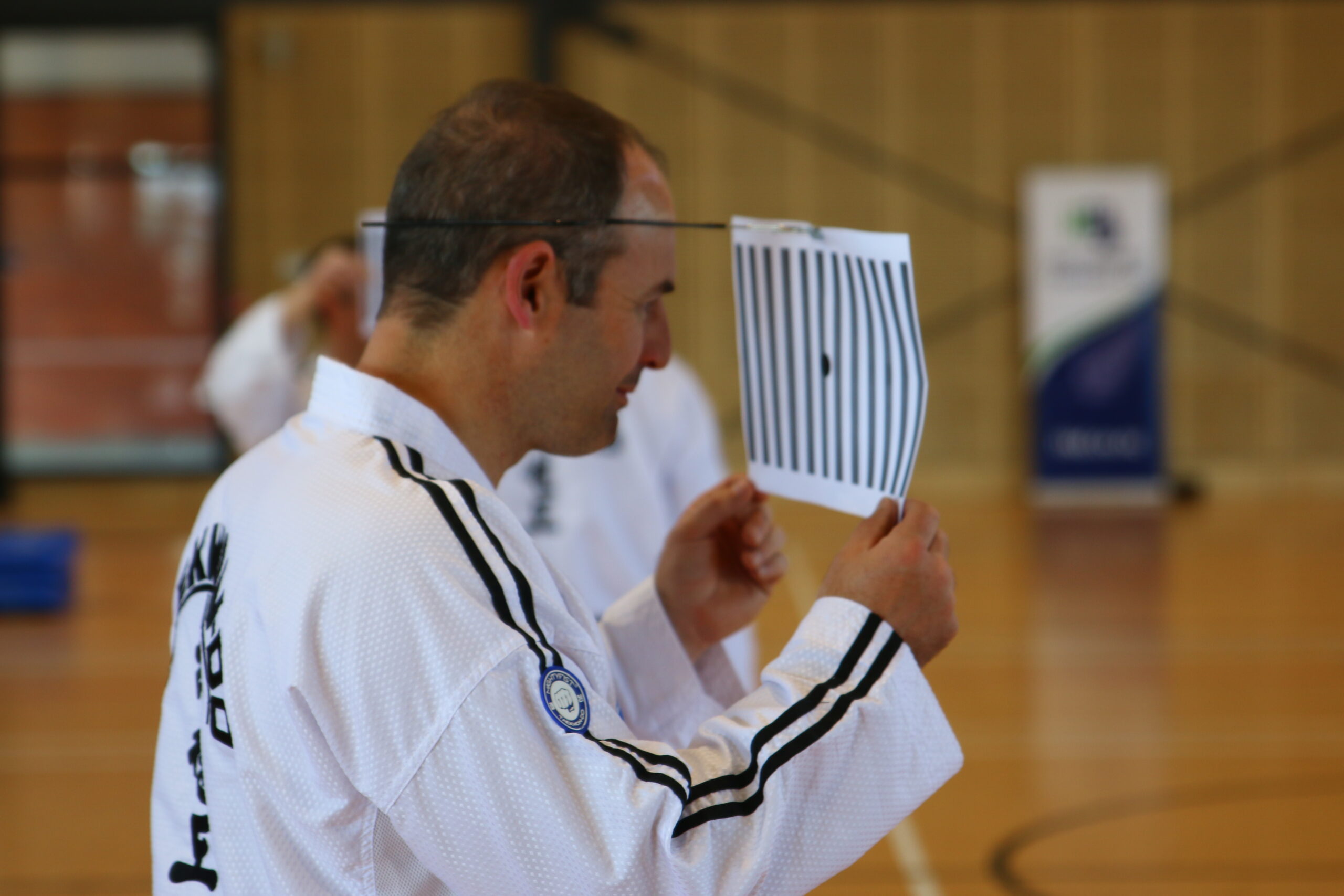
Peripheral – keep wide awareness
Peripheral vision allows us to remain aware of what is happening outside the central point of focus. In a Taekwon-Do environment, this can be valuable when dealing with movement around us without constantly moving the eyes or head. Master Nguyen used the simple cue “soft eyes – see the room.” Rather than narrowing attention onto a single point, the aim is to maintain a broader awareness of the environment. This has obvious relevance to sparring, where being aware of movement outside the immediate target can be just as important as focusing directly on an opponent.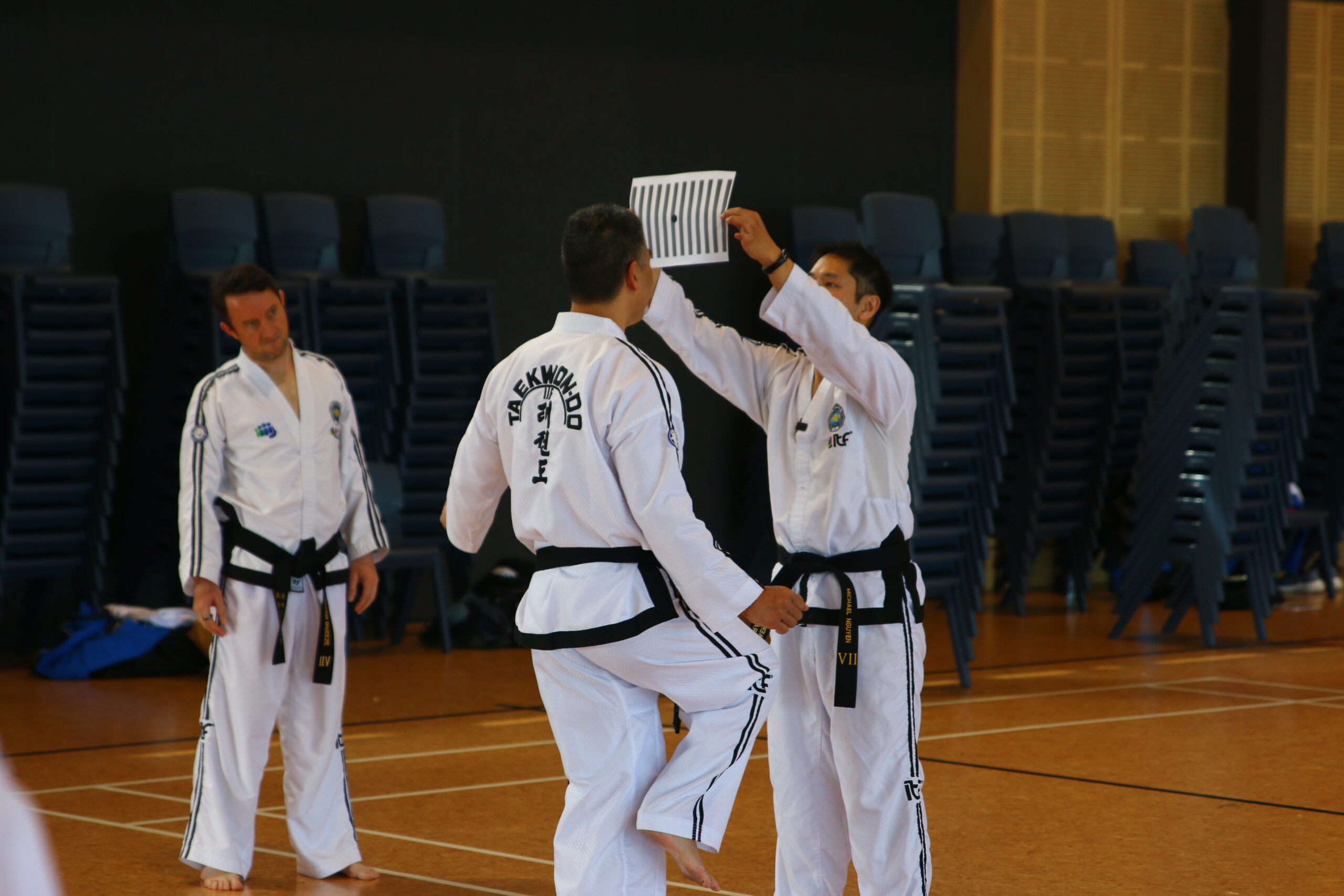
In Part 2: Pursuit – glide eyes to follow motion
Part two starts with pursuit; the ability to smoothly follow a moving target with the eyes. Unlike the rapid shifts involved in saccades, pursuit is about keeping the eyes moving smoothly with the target rather than repeatedly jumping from one point to another. Master Nguyen explored progressing from eye movement alone to coordinated eye and head movement. The goal is simple – the eyes should glide with the target rather than jump or jerk. For Taekwon-Do practitioners, this provides another way of thinking about the relationship between vision and movement. The eyes are not simply observing what is happening – they are actively helping the body understand and respond to movement.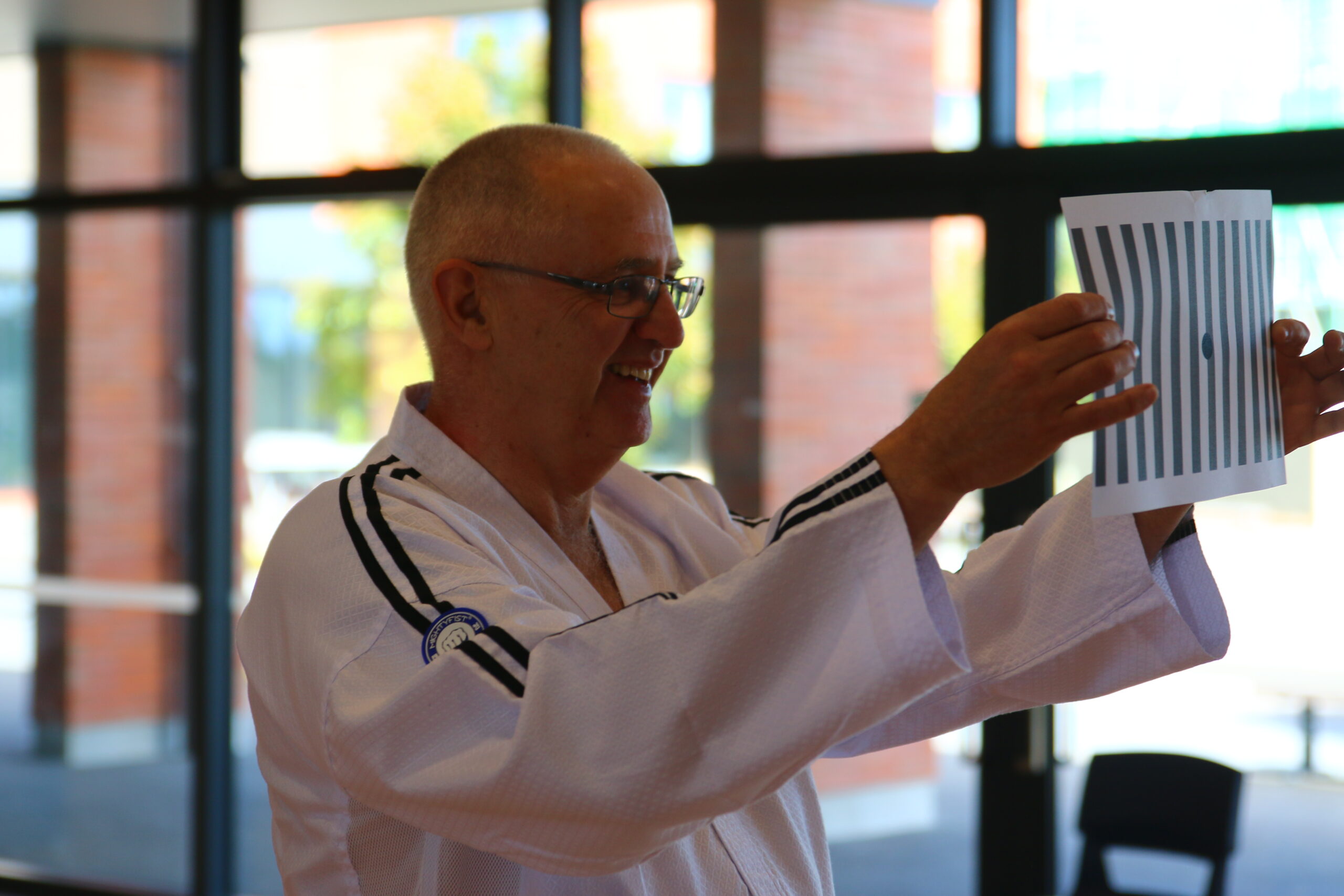
Why does this matter in Taekwon-Do?
We spend a great deal of time in Taekwon-Do developing physical skills – stance, balance, coordination, timing, speed and power. But the information that guides those physical responses is often overlooked. Vision is one of the key sources of information our brain uses to understand what is happening around us. How quickly we shift our gaze, how broadly we see, and how smoothly we track movement can all influence how we respond. That makes visual training an interesting addition to conventional Taekwon-Do practice. It does not replace technical training – it gives us another way to challenge the systems that support our movement.Meet Master Michael Nguyen
Master Michael Nguyen is a VII Degree Taekwon-Do practitioner and Head Instructor of Impact Taekwon-Do Australia. He is also an APA Neurological Physiotherapist and Director of NeuroAbility Rehabilitation in Melbourne, Australia. His clinical work focuses on neurological rehabilitation, balance, gait and movement disorders. He has a particular interest in applying principles from neuroscience and rehabilitation to Taekwon-Do training and performance. This combination of Taekwon-Do experience and clinical knowledge provides an interesting perspective on skills that are often taken for granted during training.Read more about Master Michael Nguyen
Watch the full video
The complete Balance Beyond Belts – Part 1 coaching session is available here for TKDCoaching Premium Members: Balance Beyond Belts – Part 1 – Premium VideoComing next: Balance Beyond Belts Part 2 continues with further exploration of the visual system, before moving into the vestibular and proprioceptive systems and their role in balance, movement and Taekwon-Do performance.