
Juche Tul – What the Original 1984 Manuscript Reveals
Juche Tul – What the Original 1984 Manuscript Reveals
Juche tul is perhaps one of the hardest of all the patterns to perform. But did you know it used to be even harder?
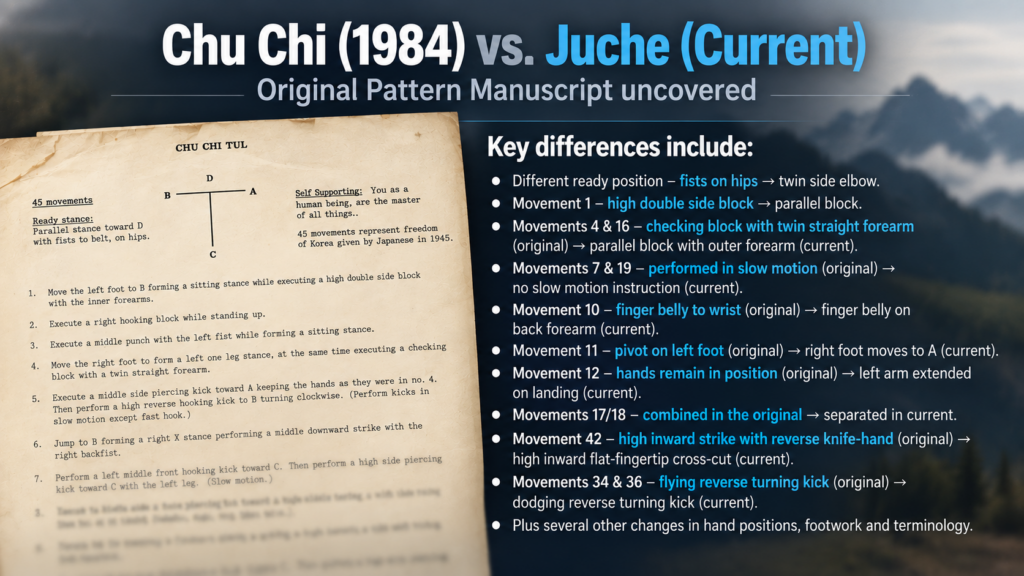
I recently uncovered my original manuscript of the pattern from when it was first introduced in 1984, and it reveals some interesting differences compared with the way Juche is performed today.
Juche was first introduced at a seminar in Brisbane, Australia, in June 1984. Master Park Jung Tae taught the pattern along with a number of other new additions, including audible breathing on movements and calling the pattern name at the end. This was also the first time we saw the Taekwon-Do Tree on the back of the dobok jacket.
One of the most significant differences in the pattern was that the side piercing kicks on movements 7 and 19 were originally performed in slow motion! This must have been changed sometime between 1984 and November 1985, when we can see video of Master Park Jung Tae performing the kick at normal speed in Norway.
An Interesting Note in the Original Manuscript
Another interesting detail concerns movements 5 and 17. The original manuscript includes the instruction:
This wording is interesting because the instruction specifically mentions a fast hook at the end of the movement. The terminology and instructions for this part of Juche have evolved over time, and this early manuscript provides an interesting glimpse into how the pattern was originally documented.
It is another example of how the original 1984 material can differ from descriptions found in later publications.
The Pattern Diagram
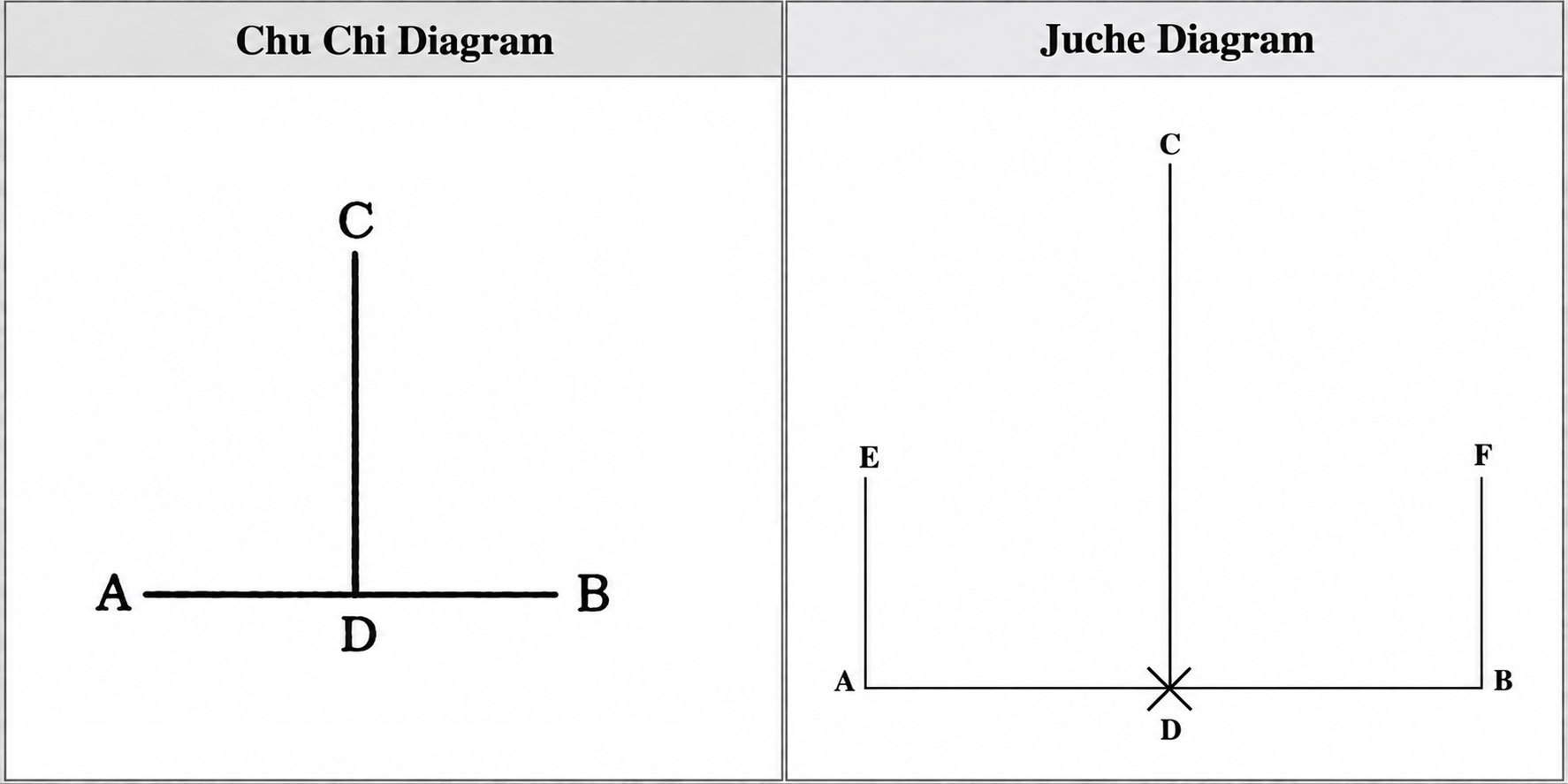
The original pattern diagram was a simple version, the EF lines were added later.
This brings up an interesting point that the original diagram was not in the shape of a mountain – which is given as the meaning of the diagram: The diagram (山) represents Baekdu Mountain.
I have often wondered if the EF lines were warranted in this diagram, as the movements stepping on those lines are only one sitting stance. It looks like General Choi may have wanted to add those lines to fit the diagram meaning. Nothing wrong with that – just interesting when things happened.
The Original Ready Posture
The ready posture is also interesting. The original manuscript describes it as:
This was changed to “Parallel stance with forefists to the hips” then later “Parallel stance with a twin side elbow.”
Why 45 Movements?
The original pattern history states that the 45 movements “represent freedom of Korea given by Japanese in 1945.”
This awkward translation was probably intended to mean something like:
Interestingly, later publications no longer included an explanation for why the pattern has 45 movements.
Other Changes
The other differences are mainly in the nomenclature, as many new technique names were introduced later, including “parallel block” and “dodging reverse turning kick”.
Summary of Differences
Here is a summary of the differences I found between the original 1984 manuscript and the terminology and instructions used later.
| Movement | Original text | Later text |
|---|---|---|
| Pattern Diagram | Simple ABCD | EF lines added |
| Ready Posture | Fists to the belt | Forefists to the hips |
| 1 & 13 | Double side block | Parallel block |
| 4 & 16 | Checking block | Parallel block |
| 7 & 19 | Slow motion | Slow motion removed |
| 10 & 22 | Finger belly brought onto the wrist | Back forearm |
| 26 | Heaven stance | Heaven hand |
| 28 & 30 | Inward strike | Crescent strike |
| 34 & 36 | Flying reverse turning kick | Dodging reverse turning kick |
| 41 | Side strike | Horizontal strike |
| 42 | Reverse knife-hand | Flat fingertip cross-cut |
The Original 1984 Manuscript
I have made the original three-page manuscript available here for anyone interested in examining the source document for themselves.
View the Original 1984 Manuscript