
So-San Pattern – Preview & Insights
So-San Pattern
So-San is a 5th degree black belt pattern with 72 movements.
So-San is a long pattern where small technical leaks become obvious: stance length drifts, breathing becomes inconsistent, and techniques start to rush. Instructors will often see students perform the early movements well, then lose crispness as fatigue builds. The goal is not just to finish, but to maintain the same standard from the first movement to the last.
Pronunciation: How to pronounce So-San correctly
Pattern Speed: – 1 minute, 45 seconds
Approximate performance time for the full pattern. Timing varies between practitioners and is provided as an unofficial guide only.
Video Preview
In the sample video above, you will see the level of detail covered in the full So-San breakdown, including practical corrections you can apply immediately. This session also features Mrs Suzanne Patterson (now Master), 7th degree black belt and former New Zealand team member and coach.
About So-San
So-San is the pseudonym of the great monk Choi Hyong Ung (1520-1604) during the Lee Dynasty. The 72 movements refer to his age when he organised a corps of monk soldiers with the assistance of his pupil, Sa Myung Dang. The monk soldiers helped repulse the Japanese pirates who overran most of the Korean peninsula in 1592.
Key Technical Insights from GM Paul McPhail
Drawing from my ongoing study and technical work within ITF Taekwon-Do, each pattern in this Hub includes a short set of key technical points – practical reminders practitioners often overlook. These notes are personal insights and are not official ITF Technical Committee statements.
Key Technical Points
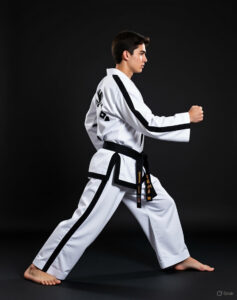 Movement 2. Vertical punch: Do not pull right back to the hip. A small amount of backward motion is acceptable. The arm bends about 40 degrees, with the thumb at solar plexus height on the shoulder line. There is very little rotation of the punching fist, as it travels only a short distance.
- Movements 5-8. Raise the body up to the walking stance, then down to the sitting stance. Perform two sets of fast motion.
- Movement 10. Side – turning kick: Keep hands out on the side kick, not on the turning kick.
- Movement 17. Low double punch: Back fist at lower abdomen level.
- Movement 18. Release: Grab the hand without bending the arm for the release. Relax so that you can reach the fist. Finish with the fingertips to the edge of the knuckles.
- Movement 34. Double arc-hand block: No sine wave.
- Movement 60. Scooping block: Slide on L-stance for scooping – maintain the length of the stance, then rise up.
- Movement 61. L-stance punch: No backward motion on the punch with shift.
Training Suggestions
- You will need to learn So-San in sections – there are natural places to break the pattern for this purpose.
- Many of the techniques are repeated, so be aware of this to make the pattern easier to remember.
- Film and review stance length, shoulder height, and whether each technique finishes on line.
A useful approach is to treat So-San like an endurance pattern for precision: the standard you set at the start must still be there at the end.
Teaching Ideas for Instructors
- Emphasise posture integrity, as So-San quickly exposes forward lean, raised shoulders, or loss of core engagement.
Isolate the combination kicking techniques for repetition before reintegrating them into the full pattern.
Encourage controlled breathing throughout the pattern to support endurance and maintain rhythm under physical stress.
Use So-San as a conditioning tool by performing it twice consecutively, challenging students to maintain technical quality while fatigued.
Incorporate video review to help students identify posture breakdown, inconsistent stances, or timing issues.
Background & Interesting Details
Hyujeong was the actual Buddhist name of the monk later honoured by the title So-San (Seosan Daesa). He was one of the most influential Seon (Zen) masters of the Joseon (Lee) Dynasty and is the historical figure commemorated in So-San tul.
During the Japanese invasions of 1592, he organised and authorised monk soldier units, despite Buddhism being politically suppressed at the time.
Why the names cause confusion
- So-San (Seosan Daesa) = pen name / honourary title (used for the pattern)
- Hyujeong = personal Buddhist name
- Yujeong = personal Buddhist name
- Sa Myung Dang = title / honourary name
Full So-San Video
The full, in-depth breakdown of So-San is available for TKDCoaching Premium Members. In this session, I cover detailed coaching points, corrections, common mistakes, and teaching progressions you can use in your own classes.