
Kwang-Gae Pattern – Preview & Insights
Kwang-Gae Pattern
Kwang-Gae is the first pattern taught at 1st dan level and forms an important bridge between colour belt and black belt performance standards. It demands a strong sense of fast and slow, hard and soft, which in turn makes for a beautiful pattern.
Pronunciation: How to pronounce Kwang-Gae correctly
Pattern Speed: – 1 minute, 15 seconds
Approximate performance time for the full pattern. Timing varies between practitioners and is provided as an unofficial guide only.
Video Preview
This clip comes from a coaching session on Kwang-Gae tul with ITF World Champion Master Mark Trotter. In this excerpt, Master Trotter works with triple World Champion Miss Roisin Giles on the consecutive kicking sequence in the pattern, focusing on structure and how to demonstrate real power without sacrificing control.
About Kwang-Gae
Kwang-Gae is named after the famous Kwang-Gae-Toh-Wang, the 19th King of the Koguryo Dynasty, who regained all the lost territories, including the greater part of Manchuria. The diagram represents the expansion and recovery of lost territory. The 39 movements refer to the first two figures of 391 A.D., the year he came to the throne.
Key Technical Insights from GM Paul McPhail
Drawing from my ongoing study and technical work within ITF Taekwon-Do, each pattern in this Hub includes a short set of key technical points – practical reminders practitioners often overlook. These notes are personal insights and are not official ITF Technical Committee statements.
Key Technical Points
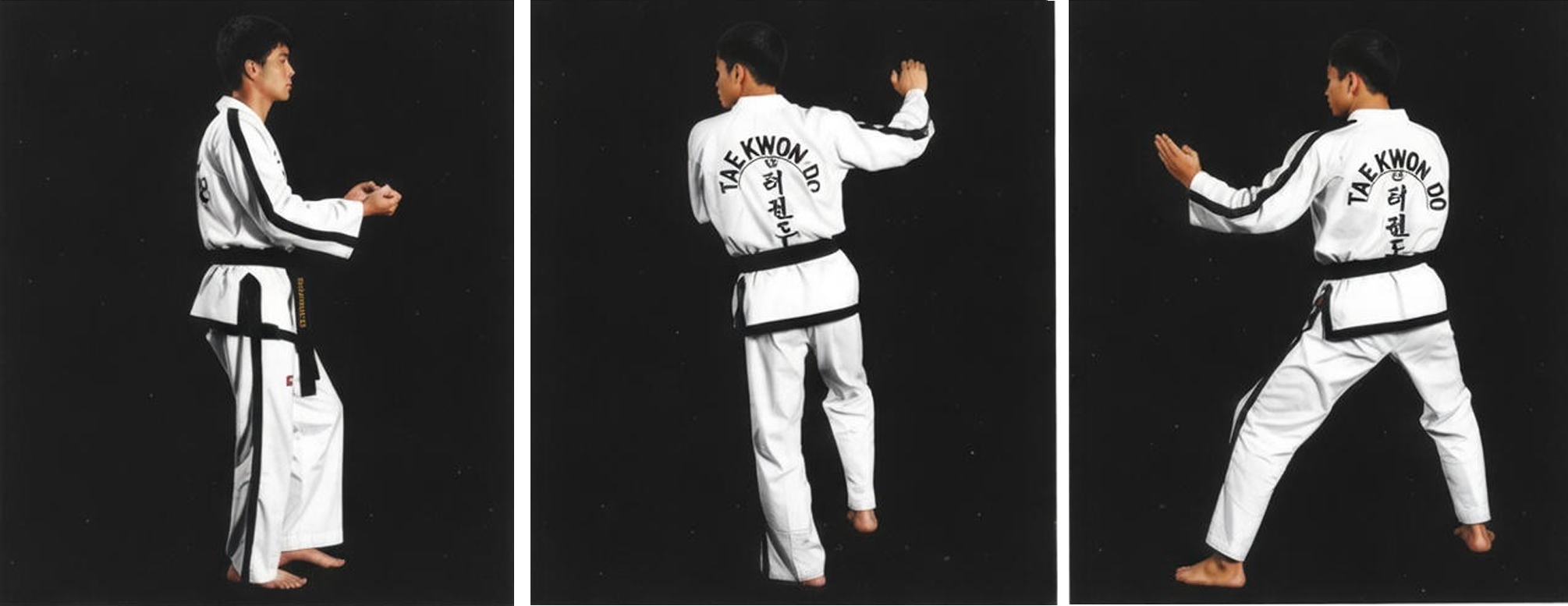
- Ready stance: Thumbs level with the nose, head tilted back.
- Movement 1: Lift the foot out a little, hands slightly wider than shoulder width.
- Movement 2. Upset punch: Performed in a circular motion.
- Movement 16. Downward strike: Normally a downward strike would start with the backfist facing up, but in this case leave the hand as it is (backfist facing down) and go directly to the strike from the inside.
- Movement 32. Twin fist upset punch: Fists no more than 5 cm in front of the body.
- Movement 33. Stepping after the front snap kicks: Step one foot slightly ahead of the other after the front snap kicks – that way the foot ends up with the toes on the same spot.

Training Suggestions
- Isolate the consecutive kicking sequence and practise it slowly before reintegrating it into the full pattern.
- Use mirror work or video feedback to check posture and hip alignment during kicking combinations.
- Run Kwang-Gae at reduced power to refine technique, then gradually increase intensity while maintaining form.
Teaching ideas for Instructors
- Reinforce that black belt patterns are not about power alone – clarity and control come first.
- Focus on clean transitions between techniques, especially where consecutive kicks are used.
- Ensure students understand the difference between relaxed readiness and sloppy posture.
Background & Interesting Details
- Kwang-Gae was the Great King of Koguryo, the largest of the Three Kingdoms.
- He ruled for 22 years and died aged 39, which also matches the number of movements in the pattern.
- The name Toh-Wang was given to him posthumously and the title means The Great. This title was only ever given to one other king, Se-Jong.
Full Kwang-Gae Video
The full, in-depth breakdown of Kwang-Gae is available for TKDCoaching Premium Members. In this session, expert coach Mark Trotter critiques the pattern movement by movement with double World Champion Miss Roisin Giles (2nd dan), providing detailed corrections, common mistakes, and coaching strategies suitable for black belt instructors.