
Won-Hyo Pattern – Preview & Insights
About Won-Hyo
Won-Hyo is named after the monk Won-Hyo (617–686 AD), who played a major role in spreading Buddhism throughout Korea. His teachings and writings had long-lasting influence across Korea, China and Japan. The pattern reflects both his spiritual insight and his impact on Korean culture.
Key Technical Insights from GM Paul McPhail
Drawing from my ongoing work and research within ITF Taekwon-Do, each pattern in this Hub includes a short set of key technical points — practical reminders practitioners often overlook. These notes are personal insights and are not official ITF Technical Committee statements.
Key Technical Points
- Movement 2. Knifehand inward strike: Attacking tool at neck height.
- Movement 7. Bending ready stance: Heel (reverse footsword) close to the knee joint. Watch how Master Hutton performs this movement here.
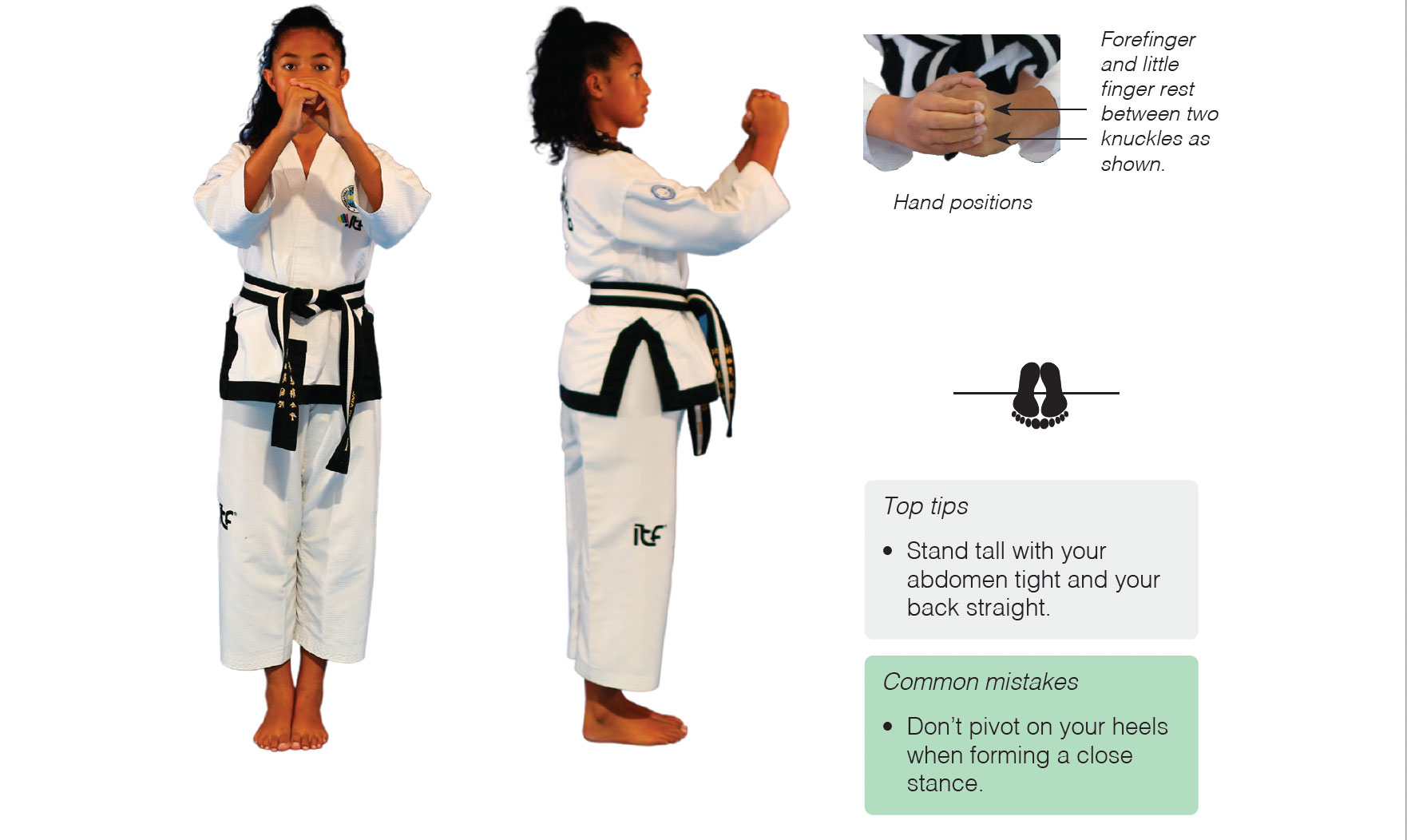
- Close ready stance A: Maintain correct hand position and upright posture; avoid leaning or dropping the elbows.
Training Suggestions
- Work hard on the first three movements of this pattern, as they are repeated four times – accounting for nearly half the pattern movements!
- Spend time on the bending ready stance and side piercing kick. That will make all the difference.
- Circular block is difficult. Make sure you understand the application and proper performance of this movement.
- Understand how the intermediate positions work and the principle of backward motion.
Teaching Ideas for Instructors
- Teach the new technical elements (stance transitions, side piercing kick, hip rotation) first, then the full pattern sequence.
- Highlight correct L-stance and fixed stance length — make sure students show the difference.
- After the right side piercing kick (movement 26), step diagonally one foot distance to return to your starting point.
Won-Hyo Background & Interesting Details
- The date 686 AD refers to the year Won-Hyo passed away. Buddhism had already reached Korea earlier, but it was Won-Hyo who helped bring it to ordinary people.
- His birth name was Sol-Sedang. He was a skilled horseman and javelin thrower, and served as a Hwa-Rang warrior before renouncing violence.
- The Skull Story: During a storm, he drank water in darkness believing it was fresh rainwater. At sunrise he realised it had been collected inside a rotten skull filled with maggots. From this he concluded: “Everything is created by the mind alone.”
- In 662 AD he left the priesthood and travelled the country teaching Buddhism, eventually influencing the entire Silla Kingdom.
- Won-Hyo authored 86 works across 240 publications. Twenty-three survive today and continue to shape Korean thought.
- He died aged 70.
Full Won-Hyo Video
The full Won-Hyo breakdown class is available to TKDCoaching Premium Members. It includes in-depth coaching points, corrections, common mistakes and teaching methods for instructors.