
Juche Pattern – Preview & Insights
Juche Pattern
Juche is a 2nd degree black belt ITF Taekwon-Do pattern (2nd dan) containing 45 movements. It is an advanced, highly dynamic tul that demands strong balance, sharp direction changes and confident use of both hands and feet.
Juche is named after the Juche philosophy, which emphasises self-reliance, independence, and the belief that humans are the masters of their own destiny. The pattern’s meaning reinforces the idea that true strength comes from within, guided by clear principles and self-belief rather than dependence on others.
Pronunciation: How to pronounce Juche correctly
Pattern Speed: – 1 minute, 25 seconds
Approximate performance time for the full pattern. Timing varies between practitioners and is provided as an unofficial guide only.
Video Preview
In this first sample, Master Trotter gives hints on the jumping aspects of the pattern. It is intended as a visual reference for 2nd dan students working on timing, balance and accurate execution.
About Juche
Juche is a philosophical idea that man is the master of everything and decides everything. It expresses the concept that a person is the master of the world and of their own destiny. It is said that this idea was rooted in Baekdu Mountain, which symbolises the spirit of the Korean people. The diagram of the pattern represents Baekdu Mountain.
Key Technical Insights from GM Paul McPhail
Drawing from my ongoing work and research within ITF Taekwon-Do, each pattern in this Hub includes a short set of key technical points — practical reminders practitioners often overlook. These notes are personal insights and are not official ITF Technical Committee statements.
Key Technical Points
- Movement 1: Parallel block: Fists at temple height.
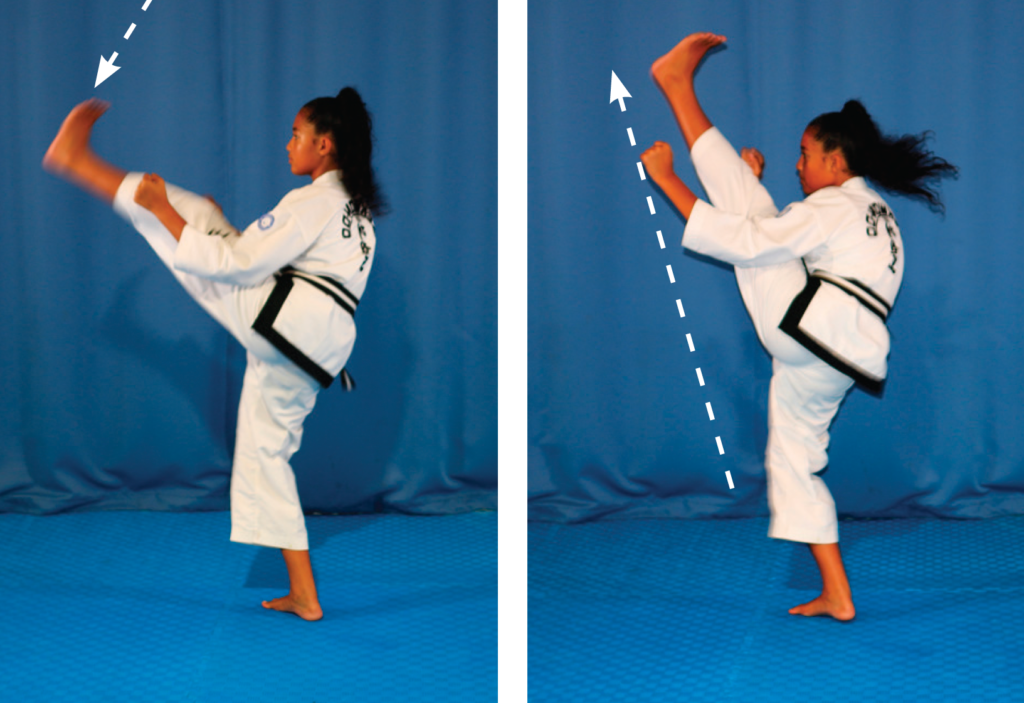
- Movement 5: Slow-motion side–reverse hooking kicks: Relax the arms slightly; no need to keep them strictly in the block position.
- Movement 7: Hooking kick: Natural motion, same as a hooking block.
- Movement 8: Cross-cut: Finish just past the eyes.
- Movement 9: High elbow strike: From the previous sitting stance, the body rises into the walking stance.
- Movement 32: Downward punch: To the shoulder line.
- Movement 37: Two-direction kick: Try to stop the kick in mid-air.
- Movement 25: Pick-shape kick: Bend the leg about 45 degrees at shoulder level.
Training Suggestions
- Break the pattern into short sections and repeat each one until you can perform it smoothly without pausing to think about the next movement.
- Train those kicks. There are a lot of them! Check out our video by Master Lylian Doulay on getting higher kicks for patterns.
Teaching Ideas for Instructors
- Remind your students that there are only a handful of difficult movements in this pattern; the majority are straightforward. This helps reduce anxiety.
- Break all the kicks down using partners, walls, pads and bags to help with balance until the student improves.
Bonus Video
In this second sample clip, Master Trotter works on the pivoting and trajectory of the slow-motion reverse hooking kicks — one of the most difficult techniques in the pattern.
Juche Background & Interesting Details
- Juche was introduced in 1984 to replace the earlier pattern Ko-Dang in the official ITF syllabus. Some organisations still practise Ko-Dang instead of Juche.
- For my 5th degree black belt grading in 1993 I decided to perform Juche forwards and then backwards for General Choi. Unfortunately, he turned his head and refused to watch the backwards part — but I carried on anyway….
 Here is footage of that pattern from the grading.
Full Juche Video
The full Juche breakdown class is available to TKDCoaching Premium Members. It includes in-depth coaching points, corrections, common mistakes and teaching methods for instructors working with advanced black belts.
Watch the full Juche breakdown video (Premium)