
Chon-Ji Pattern – Preview & Insights
TKDCoaching’s TKD Patterns Hub provides instructors with clear teaching insights, coaching cues, and step-by-step guidance for every ITF pattern. This page offers an instructor-focused preview of Chon-Ji, highlighting key technical details, common errors to watch for, and practical coaching ideas you can apply immediately in class.
Chon-Ji Pattern
Chon-Ji is the first ITF Taekwon-Do pattern (tul) and the beginning of every student’s formal patterns journey. This page includes a demonstration and provides guidance for instructors and keen students who already know the basic sequence.
This is not a step-by-step teaching tutorial. Instead, it helps you check the basics of the the pattern with information, photos and a preview video.
Pronunciation: How to pronounce Chon-Ji correctly
Pattern Speed: – 27 seconds
Approximate performance time for the full pattern. Timing varies between practitioners and is provided as an unofficial guide only.
Video Preview
Here is a preview of our full step by step video of Chon-Ji by Mark Trotter, available to Premium Members.
About Chon-Ji
Chon-Ji means “Heaven and Earth” and symbolises the creation of the world. It is the first pattern taught in ITF Taekwon-Do and is required at 9th gup.
Chon-Ji contains 19 movements and follows a plus-shaped diagram, representing the separation of heaven and earth. Although simple in appearance, it introduces many fundamentals that continue through the entire ITF patterns system, including:
- Walking stance structure
- Low block and middle punch mechanics
- Use of the reaction hand
- Balance and directional changes
- Maintaining a steady rhythm and sine wave
Opening movement in Chon-Ji tul
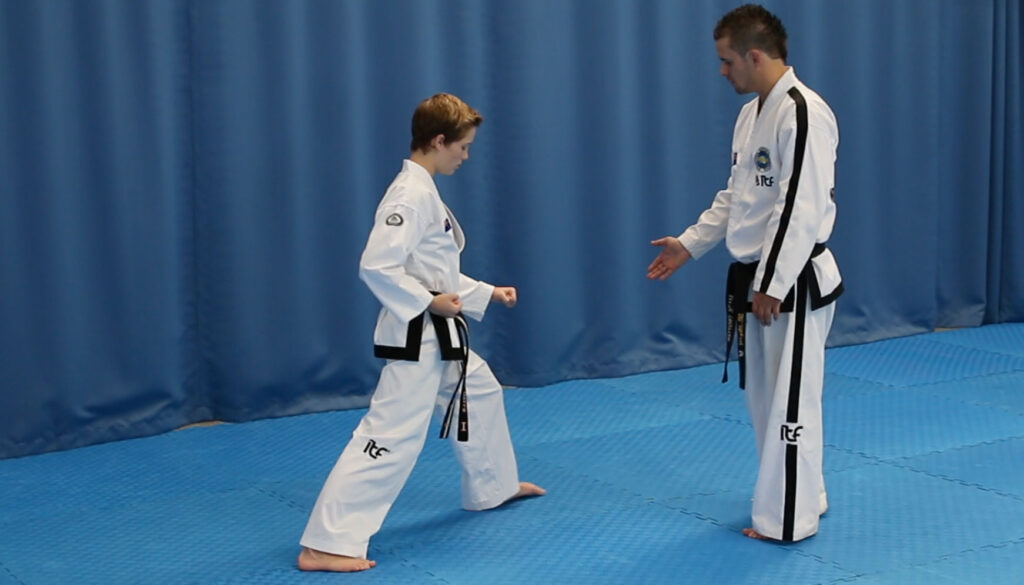
The first movement in Chon-Ji is called a walking stance forearm low block.
Middle punches – all in walking stance
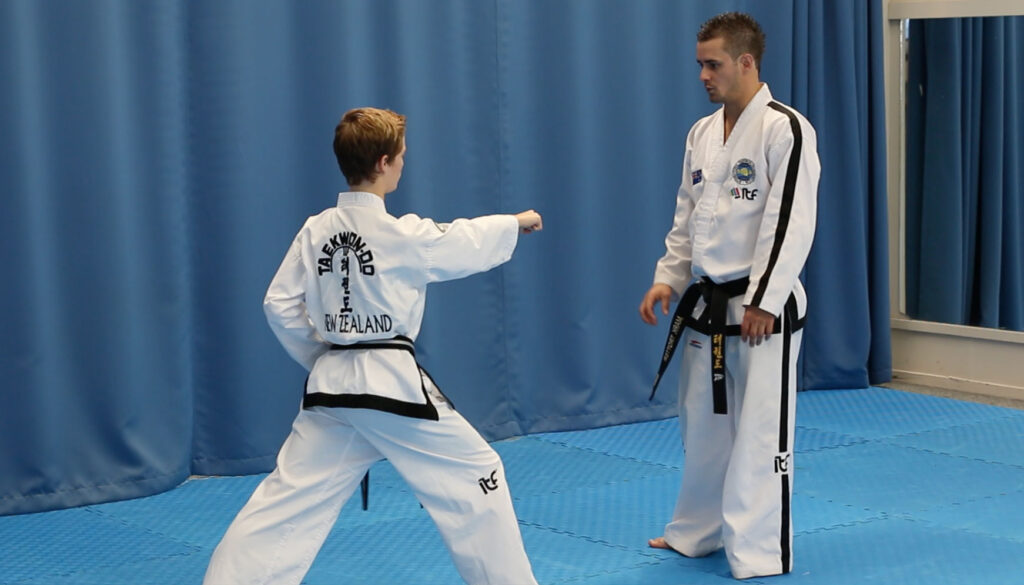
There are eleven middle punches in Chon-Ji tul – all performed in walking stance.
Inner forearm block
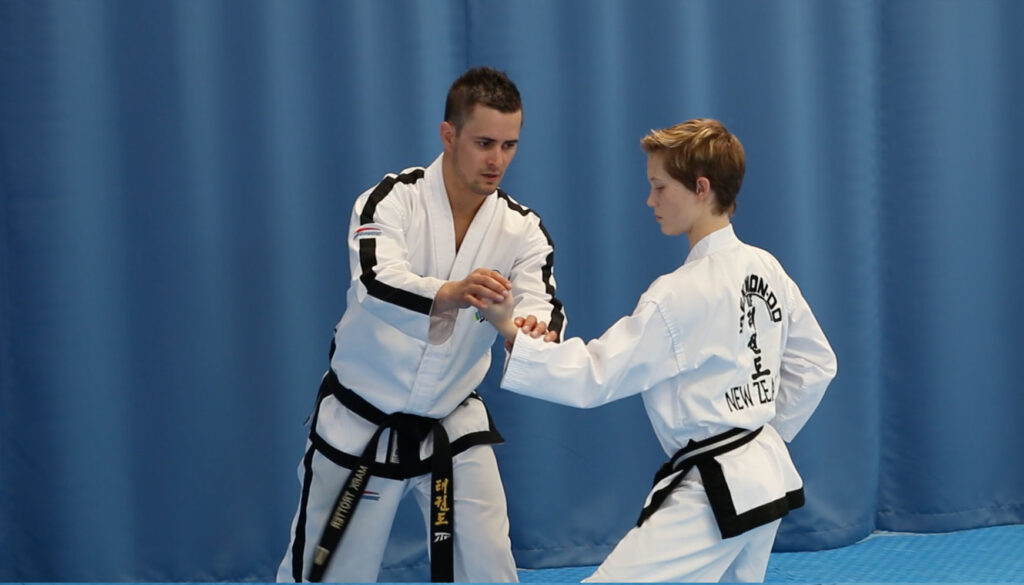
Mark Trotter correcting the height of the inner forearm block.
Key Technical Insights from GM Paul McPhail
Drawing from my ongoing work and research within ITF Taekwon-Do, each pattern in this Hub includes a short set of key technical points — practical reminders practitioners often overlook. These notes are personal insights based on decades of experience and are not official ITF Technical Committee statements.
Key Technical Points
- Movement 1. Forearm low block: The block finishes on the chest line, with the forearm correctly aligned to protect the lower body.
- Movement 2. Middle front punch: Maintain square shoulders with the index finger knuckle on the solar plexus line.
- Movement 9. Inner forearm block: Angle of the elbow is about 45 degrees — not too open or too closed. Block finishes with the fist aligned with the centre of the shoulder.
- Stances: It is important to move and pivot on the ball of the foot when turning.
- Use of the hip: For further insight into jhip movement with these basic movements, check out the Founder Of Taekwon-Do talking about and demonstrating the low block here.
Training Suggestions
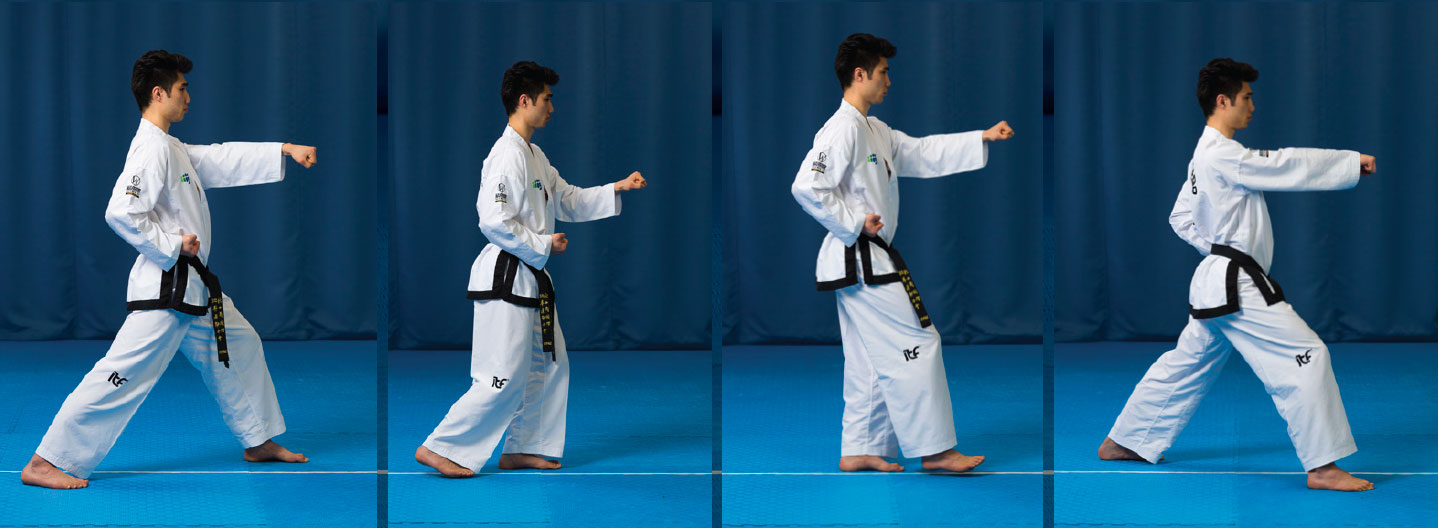
Understanding Sine Wave in ITF Taekwon-Do
When stepping in walking stance:
- Relax and bend both arms and legs as you move forwards. Your head will dip down slightly, and both hands will come in front of you.
- As you move past your stationary foot, raise your head and torso upwards, and bring both hands into the intermediate position for the next movement in a backward motion.
- Your head and torso will drop as you fall downwards into your new stance, while you accelerate both hands
Teaching Ideas for Instructors
- Practise the first four movements separately to establish correct turning and stance alignment.
- Use slow stepping drills to develop balance, weight transfer and a consistent stance length.
- Perform the pattern on counts, then in the student’s own time, to develop both accuracy and flow.
- Film students performing the pattern and review posture, stance length and block alignment.
- Demonstrate simple applications so students understand the purpose behind each movement.
- For some fun ideas of teaching patterns, visit our post all about making teaching patterns fun.
Chon-Ji Background & Interesting Details
- Chon-Ji was developed in Malaysia between 1962 and 1964 with the help of Master Kim Bok Man and Master Woo Jae Lim.
- Legend has it that Lake Chon-Ji was where Dan-Gun first lived and is the highest peak in Korea, often referred to as the “Roof of Korea”.
- With Chon-Ji being seen as the birthplace of the Korean nation, it is no surprise that General Choi chose it to be the first of the patterns, despite it not actually being the first pattern designed.
Frequently Asked Questions about Chon-Ji
How many movements does Chon-Ji have?
Chon-Ji has 19 movements.
What level learns Chon-Ji?
It is the first pattern taught at 9th gup.
What does Chon-Ji mean?
Chon-Ji means “Heaven and Earth,” symbolising the beginning of all things.
Where can I watch a full breakdown?
Normally inside the Premium Members area – see links below.
Full Chon-Ji Breakdown
The full Chon-Ji breakdown is available to TKD Coaching Premium Members. It includes detailed coaching points, corrections, common mistakes and teaching methods.
 Watch the full Chon-Ji breakdown video (Premium)
More TKD Patterns and Resources
Full pattern history of Chon-Ji
Provided exclusively by TKDCoaching.
TKD Patterns Hub – patterns and instructor-focused insights
Explore more pattern previews and coaching notes for all 24 ITF tuls.
Full breakdowns for all 24 ITF Taekwon-Do patterns
are available to TKDCoaching Premium Members.
Become a Premium Member
Learn more about our premium membership, and gain access to over 270 hours of video footage
plus downloadable resources.