
Ul-Ji Pattern – Preview & Insights
TKDCoaching’s TKD Patterns Hub provides instructors with clear teaching insights, coaching cues, and step-by-step guidance for every ITF pattern. This page offers an instructor-focused preview of Ul-Ji, highlighting key technical details, common errors to watch for, and practical coaching ideas you can apply immediately in class.
Ul-Ji Pattern
I first saw this pattern at a seminar in Brisbane in 1984, performed by Master Park Jung Tae. It made a lasting impression on me, and I have loved the pattern ever since.
The pattern starts with a flurry of movements, turning and spinning backwards from the ready stance with the arms crossed in front of the chest. It then shoots off in another direction with a series of interesting movements, including the only single fast-motion movement in all of the patterns.
The pattern finishes with sliding and leaping backwards in a series of attack-and-retreat movements, symbolic of the hit-and-run tactics of General Ul-Ji himself.
Pronunciation: How to pronounce Ul-ji correctly
Pattern Speed: – 55 seconds
Approximate performance time for the full pattern. Timing varies between practitioners and is provided as an unofficial guide only.
Video Preview
In this sample video, Mark Trotter and GM McPhail perform Ul-Ji together in a short excerpt from the end of the full coaching session.
About Ul-Ji
Ul-Ji is named after General Ul-Ji Moon Dok who successfully defended Korea against a Tang’s invasion force of nearly one million soldiers led by Yang Je in 612 AD. Ul-Ji employing hit and run guerilla tactics, was able to decimate a large percentage of the force. The diagram represents his surname. The 42 movements represents the author’s age when he designed the pattern.
Key Technical Insights from GM Paul McPhail
Drawing from my ongoing study and technical work within ITF Taekwon-Do, each pattern in this Hub includes a short set of key technical points – practical reminders practitioners often overlook. These notes are personal insights and are not official ITF Technical Committee statements.
Key Technical Points
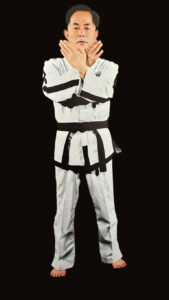
- Ready stance. Fingers at philtrum level.
- Movement 9. Backfist side back strike: Cross the arm from underneath.
- Movement 15. High front strike: No downward sine wave when standing up.
- Movement 19: Ready stance: Perform at normal speed, not slow motion.
- Movement 30: Wedging block to side front snap kick: Keep the body half-facing and look towards the kick.
- Movement 32: Pushing block (movement 32): Hand comes to chest line, normal breathing, knuckles at shoulder height.
Training Suggestions
- The variety of movements in Ul-Ji creates natural interest, so very little extra motivation is needed to inspire practitioners to give a strong performance.
- Place markers on the floor at the starting and other key points in the pattern. Practise the pattern, then check how far you finish from the marker. Repeat the process and aim to reduce the distance each time.
- If you solve the drift problem, Ul-Ji becomes far more enjoyable to perform.
- Make use of our mid-air kick videos to help perfect this key movement – such as Teaching the Mid-Air kick.
Teaching Ideas for Instructors
- Teach the history alongside the pattern itself. Explaining Ul-Ji’s hit-and-run guerrilla tactics helps inspire and contextualise the pattern for new 4th degrees.
- Practice the backward jump early as this is difficult. Many students struggle more with moving backwards than jumping forwards. Focus on a confident take-off, tuck, and a stable landing.
- Coach dynamic intent without rushing. Ul-Ji should look powerful and decisive, but not hurried. Cue students to fully settle after jumps and kicks, briefly stabilising stance and posture so each dynamic action finishes cleanly and under control.
Background & Interesting Details
- Ul-Ji Moon Dok was remembered not only as a general, but also as a skilled strategist who deliberately used psychological warfare, sending poems and messages to demoralise the invading army before decisive engagements.
- His most famous victory, the Battle of Salsu (612 AD), is considered one of the greatest military defeats in East Asian history, with records claiming only a fraction of the invading force survived the retreat.
- Some historical texts credit Ul-Ji with deliberately allowing the enemy to advance deep into Korea, stretching supply lines before launching counterattacks rather than engaging in direct confrontation early.
- The Ul-Ji pattern was included to honour intelligence, patience, and strategic restraint, qualities that contrast with the more overt heroism represented in other patterns.
Frequently Asked Questions about Ul-Ji
- What grade is Ul-Ji for?
Ul-Ji is a 4th dan ITF pattern with 42 movements. - What are the most common mistakes in Ul-Ji?
Not finishing back on the starting spot. This usually takes some investigation to identify where small directional or stance errors are causing drift. - How should I introduce Ul-Ji to new 4th degrees?
Teach the new techniques and kicking sequences first, then introduce the entire pattern gradually.
Full Ul-Ji Breakdown
The full, in-depth breakdown of Ul-Ji is available for TKDCoaching Premium Members. In this session I cover detailed coaching points, corrections, common mistakes, and teaching progressions you can use in your own classes, including practical tips to help you arrive back on the starting spot with accuracy.
In the full Premium session, Master McPhail coaches World Champion Mark Trotter through Ul-Ji and gives practical tips for one of the most common problems – drifting away from the starting spot. The video finishes with Mr Trotter and Master McPhail performing the pattern together.
 Watch the full Ul-Ji breakdown video (Premium)
More TKD Patterns and Resources
TKD Patterns Hub – patterns and instructor-focused insights
Explore more pattern previews and coaching notes for all 24 ITF tuls.
Related pages:
Insights on All 24 Patterns by GM McPhail
Favourite Pattern Survey – we’d love to know what you think
Become a TKDCoaching Member
If you find these pattern insights helpful, you’ll love the full TKDCoaching library. Premium Members get access to complete breakdowns, instructor courses, warm-ups, sparring sessions, self-defence modules and much more.