
Toi-Gye Pattern – Preview & Insights
About Toi-Gye
Toi-Gye is the pen name of the noted scholar Yi Hwang (16th century), a leading authority on neo-Confucianism and one of Korea’s most respected philosophers and educators. The pattern contains 37 movements, referring to his birthplace on the 37° latitude, and the diagram (±) represents “scholar”.
The pattern was developed in Malaysia between 1962 and 1964 with the help of Master Kim Bok Man and Master Woo Jae Lim.
Toi-Gye (“returning stream”) is the pen name of Yi Hwang (1501-1570), considered Korea’s most important philosopher. A Neo-Confucian scholar and poet who held 29 different government posts over his lifetime, Yi Hwang founded the Dosan Seowon, an elite private educational academy which operated for over 400 years.
Key Technical Insights from GM Paul McPhail
Drawing from my ongoing study and technical work within ITF Taekwon-Do, each pattern in this Hub includes a short set of key technical points – practical reminders practitioners often overlook. These notes are personal insights and are not official ITF Technical Committee statements.
Key Technical Points
- Movement 2. Upset fingertip thrust: Start the movement from the previous half-facing position to utilise your hips in the movement.
- Movement 3. Backfist side back strike: Inner forearm finishes on the outside of the shoulder line, forearm at lower abdomen level.
- Movement 12. Twin side elbow thrust: Cross the forearms in front of the umbilicus.
- Movement 19. Low pushing block: Finishes halfway between chest and shoulder line. Do not over-tense your back shoulder.
- Movement 20. Grab: Grab to the head – extend, but not with impact.
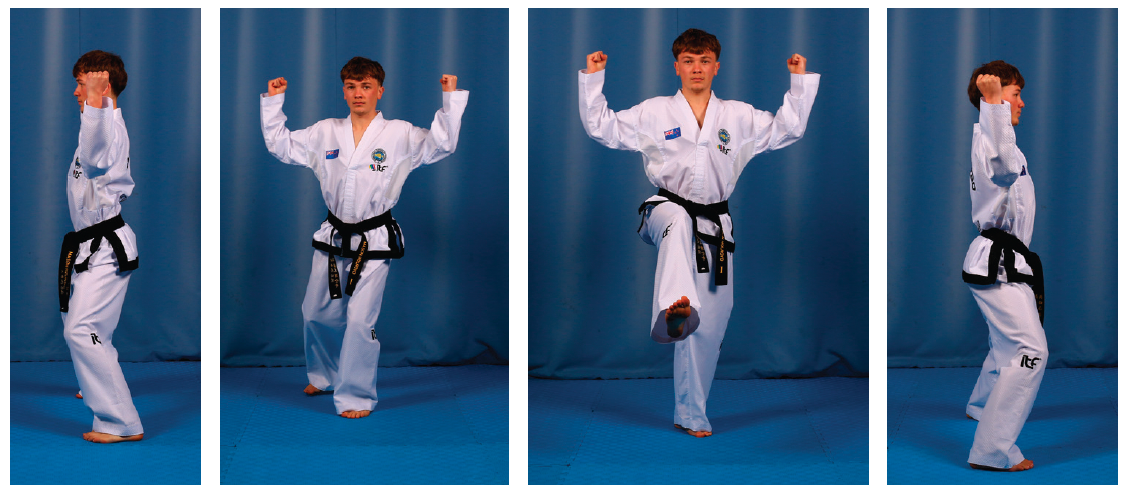
- Movement 21. Upward kick: Drop hands to chest level.
Training Suggestions
- Emphasise correct stance length both down and back in the pattern diagram. This is important to be able to get back on the starting spot.
- Focus on relaxation and breathing control to avoid unnecessary tension, particularly in the slow motion movements.
- Work on the W-shape blocks. This will make-or-break your Toi-Gye performance. If you get good at this movement, you will love the pattern. See Master Mariusz Steckiewicz’s premium video on this topic for more technical insight.
Teaching Ideas for Instructors
- Have students maintain consistent stance length and direction so the pattern returns cleanly to the starting point.
- In the W-shape blocks, coordinate the legs, body and arms so the block finishes with the forearms vertical and the elbows slightly lower than the shoulders.
Background & Interesting Details
- The pattern is named after Yi Hwang, who started to write poetry when he was twelve, and the poem he wrote at 18 years of age is admired throughout the world. This was when he first used the pen name Toi-Gye.
- As Buddhism went into decline in Korea, the Neo-Confucian philosophies of both Toi-Gye and his younger contemporary Yul-Gok became popular.
- He died aged 70, having been in public service for 37 years, serving four Kings and holding 29 different government positions.
- Toi-Gye remains the most important philosopher in Korea’s history. He – along with the academy he founded, Dosan Seowon – appears on the 1,000 won note, the most commonly used banknote. As well as multiple institutes and libraries named in his honour and dedicated to his philosophies in Korea, there are also research institutes in Japan, Germany, the United States, and Taiwan.
Physically, Toi-Gye is famous for its six W-shape blocks. Why six in a row, you ask?
Check out General Choi’s answer here
Frequently Asked Questions about Toi-Gye
- What grade is Toi-Gye for?
Toi-Gye is learned at red stripe level. - What are the most common mistakes in Toi-Gye?
Inconsistent stance length that causes the pattern to drift off line, over-tensing the shoulders during the low pushing block, and losing coordination or correct finishing positions during the W-shape block sequence. - How should I introduce Toi-Gye to new 3rd gup students?
Teach it in short directional segments first, then add the six consecutive W-shape blocks as a dedicated focus area using slow motion practice and clear finishing-position checks before rebuilding the full pattern.
Full Toi-Gye Breakdown
The full, in-depth breakdown of Toi-Gye is available for TKDCoaching Premium Members. In this session Master Trotter covers detailed coaching points, corrections, common mistakes, and teaching progressions you can use in your own classes.
👉 Watch the full Toi-Gye breakdown video (Premium)
More TKD Patterns and Resources
TKD Patterns Hub – patterns and instructor-focused insights
Explore more pattern previews and coaching notes for all 24 ITF tuls.
Related pages:
Insights on All 24 Patterns by GM McPhail
Favourite Pattern Survey – we’d love to know what you think
Become a TKDCoaching Member
If you find these pattern insights helpful, you’ll love the full TKDCoaching library. Premium Members get access to complete breakdowns, instructor courses, warm-ups, sparring sessions, self-defence modules and much more.