
Ge-Baek Pattern – Instructor Preview & Insights
TKDCoaching’s TKD Patterns Hub provides instructors with clear teaching insights, coaching cues, and step-by-step guidance for every ITF pattern. This page offers an instructor-focused preview of Ge-Baek, highlighting key technical details, common errors to watch for, and practical coaching ideas you can apply immediately in class.
Ge-Baek Pattern
Ge-Baek is a 1st dan black belt pattern with 44 movements. It emphasises strong fundamental techniques and a demanding flying side kick that requires both height and distance. For many students it marks a clear step up in precision, balance, and power across the first dan patterns.
Pronunciation: How to pronounce Ge-Baek correctly
Pattern Speed: – 1 minute, 5 seconds
Approximate performance time for the full pattern. Timing varies between practitioners and is provided as an unofficial guide only.
Video Preview
This clip comes from a coaching session on Ge-Baek tul with ITF World Champion Master Mark Trotter. In this segment, Master Trotter focuses on the flying side kick, breaking down how to judge the correct jumping distance, maintain body alignment in the air, and land with enough stability to continue the pattern without losing power or balance.
Bonus Video
Triple World Champion Roisin Giles performs the first dan ITF pattern Ge-Baek with world-class precision. This demonstration is an excellent reference for students, instructors, and anyone wanting to study the finer details of rhythm, sine-wave, accuracy, and timing. Roisin is one of New Zealand’s most accomplished ITF athletes, known for her technical quality, balance, and clean execution throughout all patterns.
About Ge-Baek
Ge-Baek is named after Ge-Baek, a great general in the Baek Je Dynasty (660 A.D). The diagram( I) represents his severe and strict military discipline.
Key Technical Insights from GM Paul McPhail
Drawing from my ongoing work and research within ITF Taekwon-Do, each pattern in this Hub includes a short set of key technical points – practical reminders practitioners often overlook. These notes are personal insights and are not official ITF Technical Committee statements.
Key Technical Points
- Movement 7. Double arc-hand block: Defending against an attack coming from the front or side front. Start with the palms slightly to the left (for the right block and vice versa).
- Movement 9. Scooping block: Performed in a natural motion.
- Movement 11. Backfist front strike: At the start of the movement the other arm extends to about solar plexus height, arm slightly bent.
- Movement 23. Flying side kick: Travel forward the distance of one walking stance from the rear foot.
- Movement 34: Step after turning kick is similar to the step after the side piercing kick in Won-Hyo (movement 26).
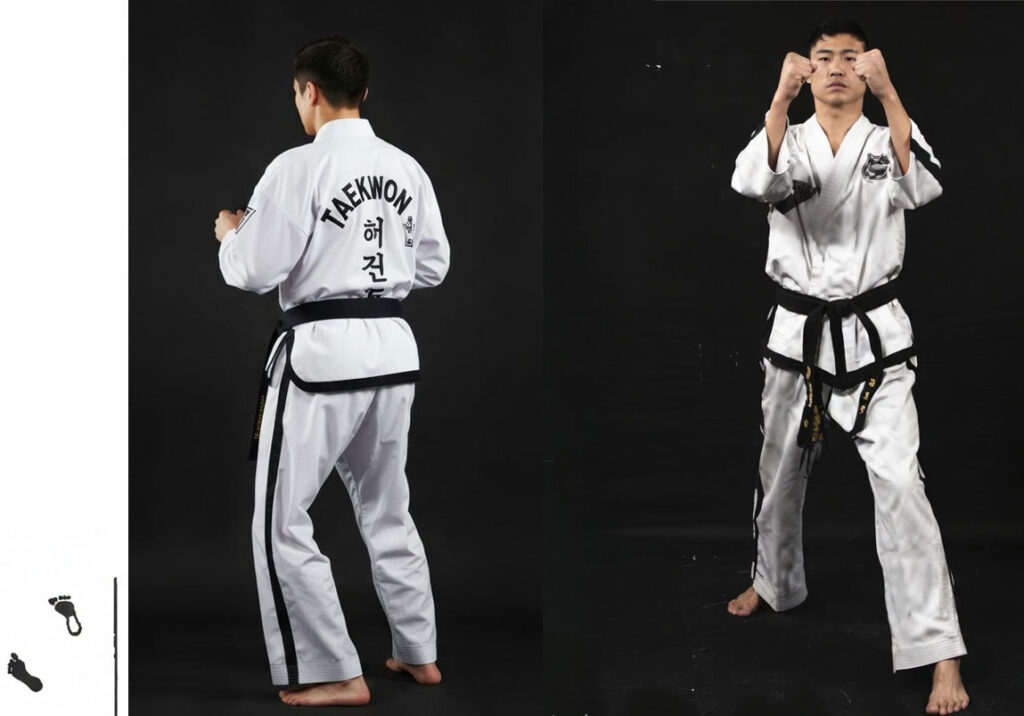
Training Suggestions
- Focus on strong maintaining power and rhythm through the entire pattern.
- Pay close attention to balance during the turning kick, flying side piercing kick and landing in a stable stance. The flying kick should have the correct chamber, posture, and recovery.
- Train the pattern in slow-motion as a warm-up, then gradually increase to full speed and power.
- Check out our video on Ge-Baek from the ITF On-line IIC.
Teaching ideas for Instructors
Break the pattern into sections when teaching, as Ge-Baek is physically demanding and concentration often drops toward the end.
Use Ge-Baek to reinforce the link to military spirit, reflecting the pattern’s historical background.
Work on all the kicks in isolation before reintegrating them into the pattern to improve confidence and accuracy.
Highlight common errors such as rushed movements and loss of posture after kicking techniques.
Background & Interesting Details
- Ge-Baek studied martial arts from an early age.
- He became a famous general of the Baek Je kingdom, winning many battles against rival forces.
- In his final battle, his kingdom was invaded by General Kim Yoo-Sin and 50,000 Silla troops, while Ge-Baek could only muster about 5,000 of his own soldiers. Knowing it was effectively a suicide battle, he killed his wife and children rather than allow them to be captured and tortured!
- Despite the odds, the battle initially went in Ge-Baek’s favour. Kim Yoo-Sin then sent a Hwa-Rang warrior into Ge-Baek’s camp to assassinate him. The Hwa-Rang was captured, and Ge-Baek was so impressed with his courage that he released him and ordered him to return the next day.
- When the Hwa-Rang returned, he is said to have killed Ge-Baek’s second-in-command by kicking him from his horse with a flying kick. He was captured again and executed for his actions.
- Eventually the Silla forces surrounded and overwhelmed Ge-Baek’s army, and he and all his men were killed. The pattern preserves his legacy as a symbol of loyalty, bravery, and unwavering resolve.
Frequently Asked Questions about Ge-Baek
- What grade is Ge-Baek for, and how many movements does it have?
Ge-Baek is the third first dan black belt pattern and contains 44 movements. Alongside Kwang-Gae and Po-Eun, it forms part of the core pattern set for 1st dan students in ITF Taekwon-Do.
- What are the main technical challenges in Ge-Baek?
The biggest challenge is to maintain consistent power right through out this long pattern, while at the same time demonstrating excellent kicking ability. The flying side kick is also not easy, with good height and distance then landing in a stable posture. - How should I use these sample clips in my training?
Use Master Trotter’s coaching clip to study the mechanics of the flying side kick – distance, timing, and landing. Then compare your own performance with Roisin Giles’ demonstration, looking closely at rhythm, stance length, and the finish of each movement. Filming yourself and reviewing alongside these clips is a powerful way to spot and correct small technical errors.
Full Ge-Baek Breakdown
The full Ge-Baek breakdown class is available to TKDCoaching Premium Members. It includes in-depth coaching points, corrections, common mistakes and teaching methods for instructors.
👉 Watch the full Ge-Baek breakdown video (Premium)
More TKD Patterns and Resources
Full breakdowns for all 24 ITF Taekwon-Do patterns are available to TKDCoaching Premium Members, including multiple angles and detailed commentary to support both instructors and students.
TKD Patterns Hub – ITF Taekwon-Do patterns and instructor-focused insights
Explore more pattern previews and coaching ITF Taekwon-Do for all 24 ITF tuls.
Related pages:
Insights on All 24 ITF Taekwon-Do Patterns by GM McPhail
Favourite Pattern Survey – we’d love to know what you think
Become a Premium Member
Learn more about our premium membership, and gain access to over 270 hours of video footage plus downloadable resources.