
Do-San Pattern – Preview & Insights
About Do-San
Do-San is the pseudonym of the patriot Ahn Chang-Ho (1878–1938). The 24 movements represent his entire life, which he devoted to furthering the education of Korea and its independence movement.
(Note: In the Encyclopaedia it states that Ahn Chang-Ho’s birth year is 1876. However, I confirmed in an email with his grandson that the correct year is 1878. This is also confirmed in many other documents.)
Do-San introduces fast motion and several new techniques, including releases from a grab and a 360º turn. As with all patterns, Do-San tul should begin and end on the same spot. Ensure you understand the purpose and method of every movement in the pattern, and perform each technique with realism – relaxing during the movement and tensing at the moment of impact.
Key Technical Insights from GM Paul McPhail
Drawing from my ongoing work and research within ITF Taekwon-Do, each pattern in this Hub includes a short set of key technical points – practical reminders practitioners often overlook. These notes are personal insights and are not official ITF Technical Committee statements.
Key Technical Points
- Movement 2. Reverse punch: Learn how to perform the reverse punch on the spot, utilising sine wave. Don’t bend the back leg too much or dip excessively low.
- Movement 3. Spot turn: Practise spot turning by moving the front foot to the mid-line of the stance so you maintain balance and correct distance.
- Movement 6. Straight fingertip thrust: The other arm does not touch the elbow.
- Movement 7. Releasing: Move the arm forward only, not down. The application is for an attempted grab to the hand – release just before someone fully grabs, not once the grip is locked on.
- Movement 7. Backfist strike: Chamber the backfist from the outside, with both palms facing outwards before the strike.
- Movement 14. Front snap kick: Keep the fists at eye level when you kick to maintain good guard and posture.
Training Suggestions
- Tricky techniques first: Practise more challenging techniques (releases, 360º turn, fast motion punches) separately before combining them into the full pattern.
- Slow-motion stepping: Use slow-motion stepping drills so students can feel balance and posture through each stance transition.
- Chamber positions: Teach clear chamber positions early to avoid long-term correction habits in backfist, blocks and thrusts. Avoid un-necessary bouncing or extra motions as explained in this clip.
- Video review: Encourage students to video their performance and review stance transitions, hip use and rhythm against a reliable model (such as the Premium breakdown).
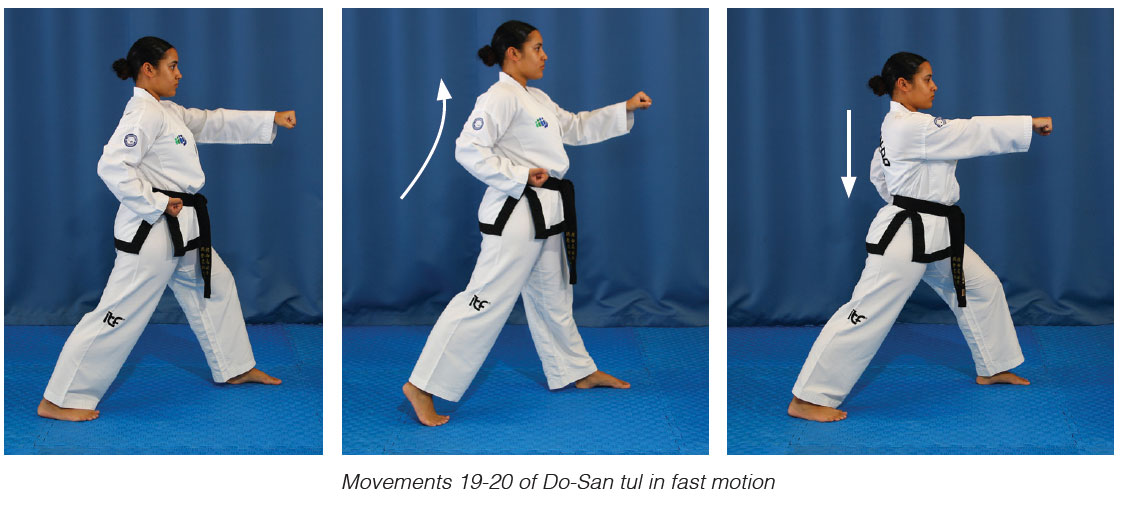
Understanding Fast Motion in Do-San
Fast motion is achieved by shortening the time between two movements so that they are executed with urgency. To do this, we truncate the sine wave between the movements by springing straight up, rather than going slightly down first. Each movement is still executed with a separate breath.
The first cases of fast motion in the patterns are in Do-San: movements 15 and 16, and movements 19 and 20, where we execute two punches in fast motion. Make sure students understand that “fast” refers to the timing between techniques, not simply rushing and losing control.
Teaching Ideas for Instructors
- Do-San introduces several new technical features for 7th gup, including outer forearm high block, straight fingertip thrust, release from a grab, backfist high strike, outer forearm wedging block, front snap kick and two punches in fast motion.
- Emphasise that this pattern is a step up from Dan-Gun. Students should show better stance control, clearer hip use and a more confident understanding of why each movement is performed.
- Reinforce the idea that the pattern must begin and end on the same spot – especially once students start learning the 360º turn and fast motion punches.
- Ensure your students are giving their best effort, even at this level. See how Master Hutton achieves this here.
Do-San Background & Interesting Details
- At age 24, Do-San (Ahn Chang-Ho) emigrated to San Francisco to gain a Western education.
- He later returned to Korea, travelled to China, and was imprisoned for independence activities.
- Despite torture and imprisonment, he died a national hero.
- His son Philip Ahn later appeared as “Master Kan” in the TV series Kung Fu.
Frequently Asked Questions about Do-San
How many movements does Do-San have?
Do-San has 24 movements.
What level learns Do-San?
Do-San is taught at 7th gup.
What does Do-San mean?
Do-San is the pseudonym of the patriot Ahn Chang-Ho (1878–1938).
Where can I watch a full breakdown?
Inside the TKDCoaching Premium Members area.
Full Do-San Breakdown
The full Do-San breakdown class is available to TKDCoaching Premium Members.
Watch the full Do-San breakdown video (Premium)
More TKD Patterns and Resources
TKD Patterns Hub – patterns and instructor-focused insights
Explore more pattern previews and coaching notes for all 24 ITF tuls.
Related pages:
Insights on All 24 Patterns by GM McPhail
Favourite Pattern Survey – we’d love to know what you think
Full breakdowns for all 24 ITF Taekwon-Do patterns
are available to TKDCoaching Premium Members.
Become a Premium Member
Gain access to over 270 hours of video instruction plus downloadable resources.