
Moon-Moo Pattern – Preview & Insights
Moon-Moo Pattern
Moon-Moo is one of the most popular and physically demanding patterns in the ITF syllabus. Its length and intensity require mature body control, strong leg conditioning, and the ability to maintain technical accuracy under fatigue. The pattern features a wide range of techniques, including high slow motion kicks, making it a true test of advanced skill.
Pronunciation: How to pronounce Moon-Moo correctly
Pattern Speed: – 1 minute, 40 seconds
Approximate performance time for the full pattern. Timing varies between practitioners and is provided as an unofficial guide only.
Video Preview
This teaser video shows World Champion Mr Mark Trotter and GM Paul McPhail performing Moon-Moo following their coaching session. It shows some of the advanced techniques required in this pattern, such as the high twisting kicks.
About Moon-Moo
Moon-Moo honours the 30th king of the Silla Dynasty. His body was buried near Dae Wang Am (Great King’s Rock). According to his will, the body was placed in the sea: “Where my soul shall forever defend my land against the Japanese.” It is said that Sok Gul Am (Stone Cave) was built to guard his tomb. Sok Gul Am is a fine example of the culture of the Silla Dynasty. The 61 movements in this pattern symbolise the last two figures of 661 AD, when Moon-Moo came to the throne.
Key Technical Insights from GM Paul McPhail
Drawing from my ongoing study and technical work within ITF Taekwon-Do, each pattern in this Hub includes a short set of key technical points – practical reminders practitioners often overlook. These notes are personal insights and are not official ITF Technical Committee statements.
Key Technical Points
- Movement 1. Bending ready stance A: Pivot the foot to 15 degrees at the same time as we lower the body.
- Movement 2. Slow side kick: Punch on both kicks.
- Movement 19. Bending ready stance B: Drop straight down, no sine wave.
- Movement 25. Palm downward block: On the chest line.
- Movement 31. Side pushing kick: Punch as you kick.
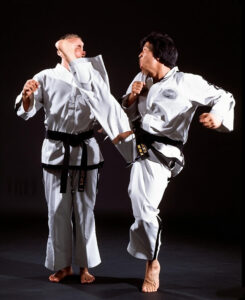 Movement 43. Twisting kicks: No arm position specified; arms naturally in front of the body. Target is to the side-rear (approximately 20 cm behind).
- Movement 44. Backfist side back technique: Other arm extends slightly bent to solar plexus height, on the shoulder line.
- Movement 49. Sweeping kick: On the first sweeping kick, keep the arm in the front technique position; on the second, no arm position is specified.
- Movement 53. Checking kicks – side thrusting kicks: Keep arms in guarding block position.
- Movement 56. X-stance punch: Target at umbilicus height, to the centre.
- Movement 60. Arc-hand rising block: Approximately 25 cm away from the forehead.
Training Suggestions
- Work on all the kicks first. Develop your strength and control to be able to do the slow motion kicks.
- Break the pattern into logical sections and train each segment under light fatigue.
- Use mirrors or video playback to check posture and stance consistency.
- Work on supporting-leg strength and endurance. Most balance issues in Moon-Moo come from a weak base rather than the kicking leg itself.
- Make use of other TKD COaching videos for help with balance and strength, such as “Balance” by Carl van Roon.
Teaching Ideas for Instructors
- Emphasise posture and balance before increasing power output.
- Coach students to manage tension deliberately. Relax between techniques while maintaining decisive execution.
- Ensure students understand the rhythm of the pattern rather than rushing to the finish.
- Reinforce clear finishes to techniques, especially after slow motion or jumping techniques. A brief moment of stability helps prevent the pattern from looking rushed or untidy.
Background & Interesting Details
- Moon-Moo is credited with completing the unification of the Three Kingdoms of Korea in 668 AD by conquering Goguryeo, making him the first ruler to oversee a nearly fully unified Korean peninsula.
- On his deathbed in 681 AD, he expressed a wish to become a sea dragon after death to eternally protect Korea from invasions, particularly from Japan, leading to his cremation and the scattering of his ashes in the East Sea.
- His underwater tomb, known as Daewangam (Great King’s Rock), is the world’s only submerged royal tomb, located offshore near Gyeongju and featuring a cross-shaped waterway symbolising his path between land and sea.
- A legend associated with his son, King Sinmun, tells of a magical bamboo flute called Manpasikjeok, grown from bamboo gifted by Munmu’s dragon spirit and General Kim Yu-sin; when played, it could calm enemies, cure illnesses, or control the weather.
Full Moon-Moo Breakdown
The full, in-depth breakdown of Moon-Moo is available for TKDCoaching Premium Members. In this session I cover detailed coaching points, corrections, common mistakes, and teaching progressions you can use in your own classes.