
Choong-Moo Pattern – Preview & Insights
Choong-Moo Pattern
Choong-Moo is the 1st gup pattern and a key stepping stone to 1st dan. It is best known for demanding kicking combinations, a flying side kick, and a 360-degree jump and spin. This is a real step up from Hwa-Rang and a suitable challenge for those aiming for their 1st dan.
Pronunciation: How to pronounce Choong-Moo correctly
Pattern Speed: – 42 seconds
Approximate performance time for the full pattern. Timing varies between practitioners and is provided as an unofficial guide only.
Video Preview
This clip comes from a coaching session on Choong-Moo tul with ITF World Champion Master Mark Trotter. Master Trotter works to improve the student’s height, timing, and execution of the flying side piercing kick – one of the most difficult elements of the pattern.
About Choong-Moo
Choong-Moo was the name given to the great Admiral Yi Soon-Sin of the Lee Dynasty. He was reputed to have invented the first armoured battleship (Kobukson) in 1592, which is said to be the precursor of the present-day submarine. The reason why this pattern ends with a left-hand attack is to symbolise his regrettable death, having no chance to show his unrestrained potentiality, checked by the forced reservation of his loyalty to the king.
Key Technical Insights from GM Paul McPhail
Drawing from my ongoing study and technical work within ITF Taekwon-Do, each pattern in this Hub includes a short set of key technical points – practical reminders practitioners often overlook. These notes are personal insights and are not official ITF Technical Committee statements.
Key Technical Points
- Movement 9. Flying side kick: Jump the distance of one walking stance.
- Movement 14. Foot position for step after turning kick: Slightly angled on the ball of the foot, then pivot fully into back kick.
- Movement 15. Back piercing kick: Lift the knee out a little so the tool arrives at 45 degrees.
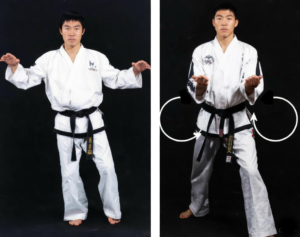
- Movement 28. Twin palm upward block: Elbows out at approximately 35 degrees, with palms on the chest line.
Training Suggestions
- For the flying side piercing kick, drill the take-off separately. Mark a start line and landing line so students learn correct distance (1 walking stance) instead of guessing.
- Utilise our video on the overhead kick, as this is normally part of the 1st dan grading requirements and will also help with the flying side kick in Choong-Moo.
- Film and review for correct intermediate and end positions for hand techniques and foot angles for kicks.
Teaching Ideas for Instructors
- Insist on consistency: the same stance length and the same technique height every time.
- Teach the flying side piercing kick separately (step, take-off, chamber, proper extension, re-chamber, landing) rather than a single movement. Getting the side kick delivered properly is one of the most difficult parts of this pattern, so work on it separately.
Background & Interesting Details
- At 31 years of age Yi Soon-Sin joined the army. His career flourished early on, but some of his seniors became jealous and falsely accused him of desertion from the battlefield, so he was stripped of his rank, imprisoned, and tortured.
- He was eventually released and allowed to fight as a simple enlisted soldier. He quickly rose through the ranks and became the commander of the Naval District. With war looming, he started to build up the Navy through a series of reforms, one of which led to the construction of the famous Kobukson.
- After many famous battles, Admiral Yi was again relieved of his command due to a plot by a Japanese agent, befriending a Korean general and convincing him he would spy on Japanese operations for them. The spy informed the Korean general that the Japanese were arriving with a great fleet of ships and that Admiral Yi should ambush them. Admiral Yi refused, as he knew the area was full of hidden sunken rocks and did not trust the information he was given. When the King was told of his refusal, he was arrested, imprisoned, and tortured to the point of death. Again, he was eventually freed and worked his way up the ranks in the Navy.
- All in all, Admiral Yi Soon-Sin had 23 victories, but the most famous was where he engaged a fleet of 333 ships with only 13 ships of his own. With 30 ships destroyed and many more damaged, the Japanese fleet retreated. Some say this could be the reason for the 30 movements in the pattern.
- Admiral Yi was struck by a stray bullet, and sensing it was fatal, he ordered one of his officers to impersonate him so as not to demoralise his men, allowing the battle to continue. He died moments later.
Full Choong-Moo Video
The full, in-depth breakdown of Choong-Moo is available for TKDCoaching Premium Members. In this session you will see expert coach Mark Trotter critique the pattern movement by movement, including corrections, common mistakes, and coaching progressions you can apply in your own classes.
Watch the full Choong-Moo breakdown video (Premium)